Experience
- 2026.07 ~ 2026.12
Frontend Developer (internship for academic credit)
Buzz & Beyond / Vling
- I work on the frontend of Vling, a SaaS for YouTube channel and video data, and shipped the video search and channel search redesigns with teammates.
- I handled the list query split, the channel cards, and URL search; teammates built the curation sections and the favorites folder feature.
- In the design system, I consolidated the filter popover and modal components.
TypeScript, React, Next.js, GraphQL (Apollo Client)
- I work on the frontend of Vling, a SaaS for YouTube channel and video data, and shipped the video search and channel search redesigns with teammates.
- 2026.09 ~ 2026.12
US Market Lead Generation
Buzz & Beyond / Vling
- I built a cold email channel for finding US B2B customers from scratch, covering lead sourcing and segmentation, an English email sequence, and sending domain setup.
- By hand-checking a sample of the lead list, I found that filtering by department alone left few actual marketers, so I added job title filters.
- When sending paused automatically as bounces rose, I traced the bounces to policy-blocked recipients and a blacklisted sending domain, removed both, and resumed sending.
- I built and ran a sending status dashboard and an unsubscribe list.
Python, Instantly, Claude Code
Projects
Hufscheerlive cheering service for university sports, backend and manager web01~04
Server on GitHub / Web on GitHub
- Hufscheer is a live cheering service for university sports. It shows scores, timelines, and lineups for on-campus soccer and basketball tournaments in real time. Users can also cheer together through cheer chat messages.
- The service has been running since 2023, and I started working on its backend in February 2026.
- From January to November 9, 2026 (GA), the service had about 7,600 active users and about 210,000 views, with up to 672 active users a day during tournaments.
- In quiet matches, spectators' WebSocket connections dropped every 2 minutes.
- I measured that connections through Cloudflare closed after 126 seconds while direct connections inside the server stayed open past 240 seconds, and traced the cause to the server's STOMP heartbeat being disabled (0,0).
- I turned the heartbeat on at 10 seconds and left a test that fails without the fix (PR #753).
- After the fix, a connection through Cloudflare on the dev server stayed up past 260 seconds.
- Several schools began sharing the service, but teams and players were not tied to a school, so a manager from any school could edit them.
- I first added a nullable school foreign key to teams and players so existing data was unaffected (Flyway).
- Then I added a permission check to 7 update and delete APIs for teams and players that allows only managers of the same school (PR #527, #543).
- When a player is created, the manager's school is assigned automatically; for teams, the school was later set through the team's college unit instead (PR #666).
Cheer Chat Spam Defense
Spam blocked, award rule rethought
~600 / minProblem scale: peak rate of identical cheer messages on a match not yet started
- Problem
- At 2 a.m., a match that had not started was flooded with identical cheer messages at up to about 600 per minute, reaching 7,617 copies of the same message in under two hours. This could distort the team ranking based on cheer counts.
- Solution
- I kept the IP limit high enough for shared school IPs so it only stops floods, and added a sliding-window limit per visitor cookie: 120 messages per 60 seconds, with the 4th identical message within 3 seconds blocked.
- Result
- The PM set the limit values, and I have not yet measured how many requests were blocked afterwards. I also found that 97% of cheer messages from the preset launch to mid-May were sent with the three preset buttons, mostly in that one flooded match, so I asked the team how the award should be decided.
Decisions and reasoning
- I saw the cheer chat count jump from the 1,000s to the 8,000s and checked the pattern in the database.
- At first I blocked by IP. A teammate pointed out that students on a school network share one IP and would be blocked together.
- After discussing it with the team, we decided to issue a visitor cookie. This lets us tell individuals apart even in a service without login.
- I raised the nginx IP limit to 6,000 per minute so it only stops floods.
- A fixed window lets through up to twice the limit if requests are sent right before and right after the boundary. So I implemented a sliding window that keeps request timestamps.
- Production runs on one server, so I kept the window in a Caffeine local cache instead of adding Redis. It can be swapped for a Redis implementation if the service moves to multiple servers.
Measurements
- On May 6, requests came in trying to raise the cheer count to 1101, 57 times per minute, and all were rejected with 400.
- But when I traced which stage blocked them, it was the value range validation, not the rate limit. A request with an in-range value would have passed.
- Since then I check which stage blocked a request, not just its response code.
Limits
- A client that does not store cookies is counted as a new visitor on every request and can avoid this limit.
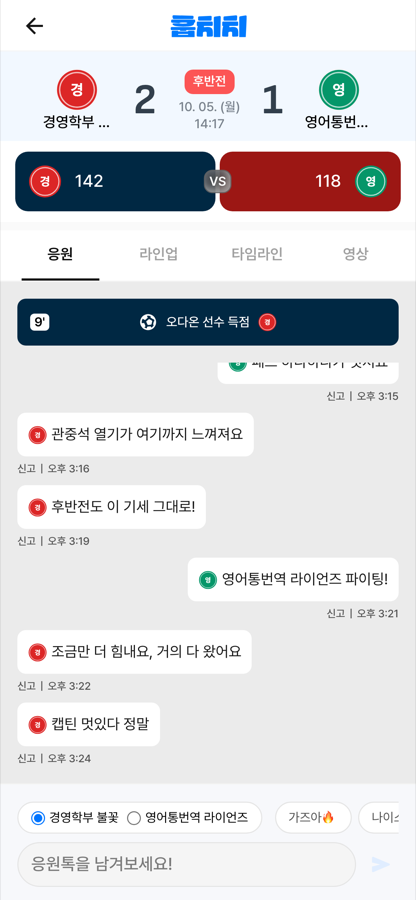
Cheering screen. Taken in a local environment with made-up data. This is not the live service screen. 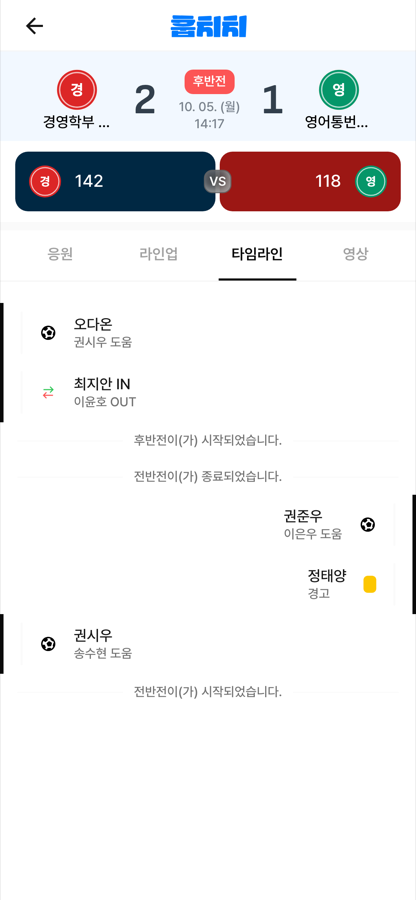
Timeline screen. Taken in a local environment with made-up data. Java, Spring Boot, Caffeine, MySQL, STOMP, sliding window
LLM Profanity Masking Improvements
Output checks block leaked explanations
- Problem
- The LLM that masks profanity returned an explanation instead of the masked sentence, and it went straight to the screen.
- Solution
- I added an output check in code to the LLM masking a teammate built, so abnormal output falls back to the original text, plus a static filter and a 5-minute cache meant to reduce LLM calls (the reduction was not measured).
- Result
- The output check catches responses that include an explanation and replaces them with the original text. I compared 9 candidate models on 22 test sentences, running each twice, and switched models (accuracy 88.6% → 100%). The same sentences were used to choose the model, so I do not treat this score as production accuracy. The effect in production has not been measured yet.
Decisions and reasoning
- Model responses vary in format even for the same input. That was the key constraint.
- A regex profanity dictionary is fast and cheap but often masks normal sentences. So I left the judgment to the LLM and set the principle to not mask when in doubt.
- Rather than leaving this principle only in the prompt, I enforced it in code at the output stage: when a check fails, the original text is used as is.
- Responses are rejected if they grew abnormally long, include the model's explanation, change the sentence without a mask marker, or drop the consonant-only cheers of the original.
Measurements
- The model I chose, gemma-4-31b, scored 100%, with a median response time of 0.5 seconds and a cost of $0.18 per 1,000 requests.
- Some reasoning models returned empty responses in other features, and some had high pass rates but produced broken output. So I chose the model by reading the outputs directly rather than relying only on pass rates.
Limits
- I have not yet confirmed that the deployed app actually calls the new model. Enforcing JSON responses also remains follow-up work.
Spring Boot, Gemini, OpenRouter, Caffeine
CI Speedup and Blue/Green Deployment
Production deploy 510s → 132s (duplicate tests removed)
510s → 132stime for one production deploy, mostly from dropping a full test suite that ran twice
- Problem
- CI swung between 8 and 17 minutes, and every deploy took the service down while the container was recreated.
- Solution
- Put the test DB on tmpfs and removed duplicate tests from the deploy job. Switched deploys to Blue/Green.
- Result
- nginx now switches to the new container only after it passes its health check. Real-time connections (WebSocket) drop at the switch and reconnect 5 seconds later. The deploy job went from 510s to 132s, mostly by removing the full test suite that ran twice in the deploy job.
Decisions and reasoning
- CI times varied because TRUNCATE ran for every test and because of the runner disk. The deploy job had been running the full test suite a second time, so I kept only the documentation tests there.
- Before a day when 2 tournaments overlapped, I considered whether to run a load test. Looking at 14 days of Prometheus data, CPU peaked at 32% and heap at 44%.
- Even on May 6, when abnormal requests flooded in, CPU stayed in single digits (3.4 to 7.6%). I decided not to do a load test, which I estimated would take 5 to 10 days.
Measurements
- Test DB time dropped from a range of 101 to 632 seconds to 54 seconds (2 runs per setup in CI).
GitHub Actions, MySQL, nginx, Docker, Prometheus
Desktop Manager Web for Tournament Organizers
97.3% of production match records from desktop
97.3% of match recordsshare of the 2,149 match records in production logs (11/02 ~ 11/26) sent from the desktop screens
- Problem
- The manager screens were mobile only, so organizers had no PC screen for registering tournaments and matches or entering records.
- Solution
- I built it with Next.js, sharing the mobile manager's TanStack Query hooks and adding the query and mutation hooks the desktop needed. After team review, I merged it into the mobile manager app as a separate route instead of a separate app.
- Result
- I shipped 19 screens to production; in production logs from 11/02 to 11/26, 95.7% of manager write requests and 97.3% of in-match records came from these screens.
Production use
- I counted every nginx log line on the production API server from November 2 to 26, split by Referer path (/desktop).
- Of 2,900 manager write requests, 2,775 (95.7%) came from the desktop screens, as did 2,092 (97.3%) of 2,149 in-match records; phones sent 0 writes apart from logins.
- Records came in for 40 matches across 3 tournaments. The desktop share of match records was 100% for the 14 Gohwang Games basketball matches, 96.9% for its 19 football matches, and 66.1% for the 7 Samgeonmul football matches.
- Desktop match records had 0 server errors (5xx) and 15 failed requests (4xx, 0.7%).
Decisions and reasoning
- The school-wide match list was incomplete when fetched as a single page, so it now follows the cursor through all pages.
- At first I split the API layer into a shared package with a separate app.
- A review pointed out that a separate app and package hurt maintainability and cohesion, so I merged it into the /desktop route of the mobile manager app (PR #612).
- I split the root layout into mobile and desktop route groups so the two screens' CSS would not mix.
- After the merge I compared 26 mobile screens at 375px with the previous version, checking element position, size, font, and color, and found no changes.
- Substitutions, record deletions, and position changes did not refetch the playing lineup, so a substituted player stayed on the record sheet.
- I made write operations invalidate the keys of the lists they affect.
- While applying PM feedback I also fixed 5 bugs, such as a date input that did not change the start time.
Defects found in production logs
- On 11/23 two devices recorded two basketball matches at the same time, but the match console fetched server data only on entry, so neither saw the other's records. In each match, one of the two devices reloaded that screen (51 and 43 times).
- I first fixed it with 5-second polling, then switched to subscribing to server STOMP notifications because polling sent too many requests. In local measurements against polling, another device's record appeared in 0.9 s instead of 3.9 ~ 4.8 s, and the viewing console's requests per 60 s fell from 72 to 18 (PR #648).
- Once another device's substitution arrived, the selected player could silently change and a goal could be saved to the wrong player; I reproduced this locally and blocked the save before release (PR #645, #646).
- After the production release (PR #647), production logs showed one match console connection staying open for 1,241 s and reconnecting 4 s after it dropped.
- Basketball fouls were counted by player name, so fouls of two same-named players on one team were combined. They are now counted by lineup id (PR #642).
Limits
- Usage shares cover only 11/02 onward, where logs remain. Match records from Mac Safari (about 19%) may have come from iPads, and logs before 11/16 lack real IPs, so I could not count users.
- Record latency was measured locally; in production I confirmed only that the connection stays open and reconnects. A teammate opened the first PR that brought it into the production branch.
Next.js, React, TypeScript, TanStack Query, STOMP
VlingBuzz & Beyond internship, frontend05~06
Vling Video Search and Channel Search Redesign
2 search screens shipped
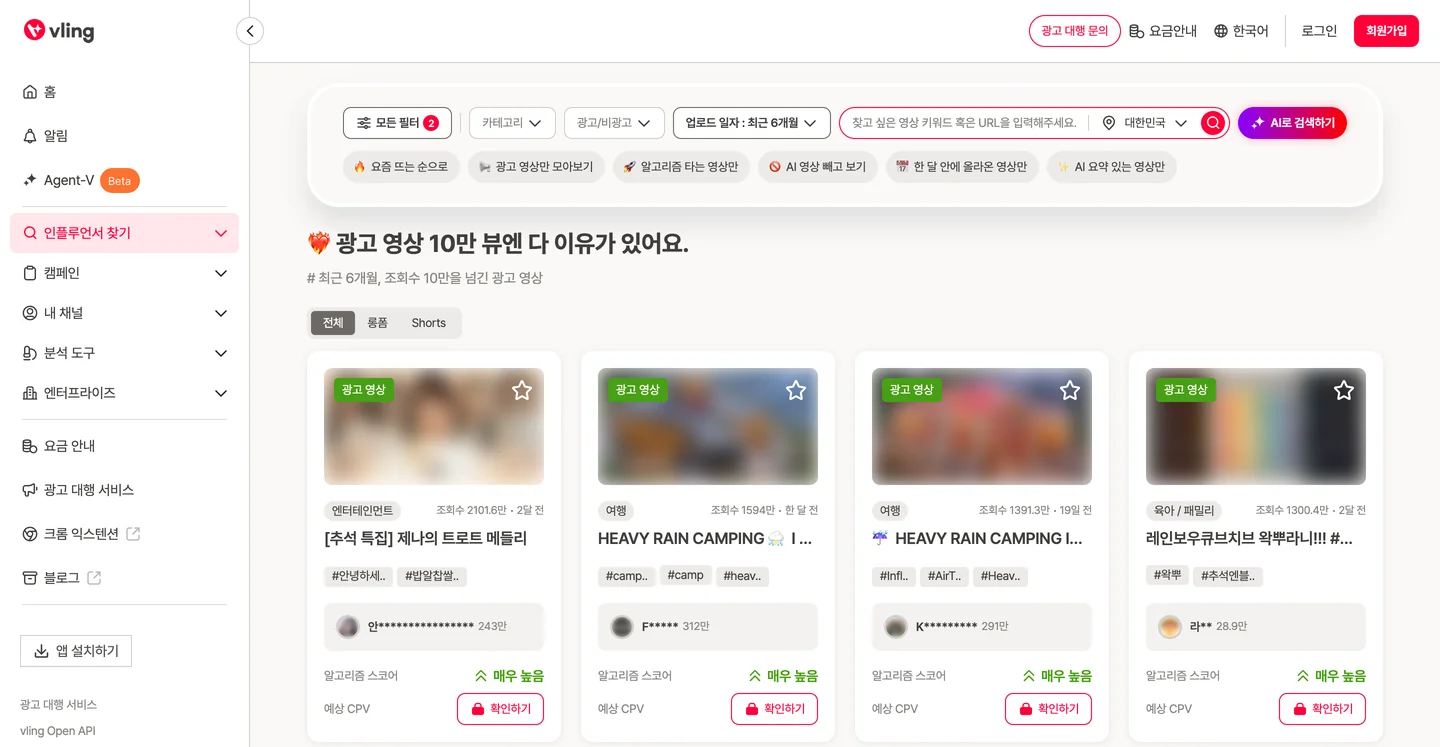
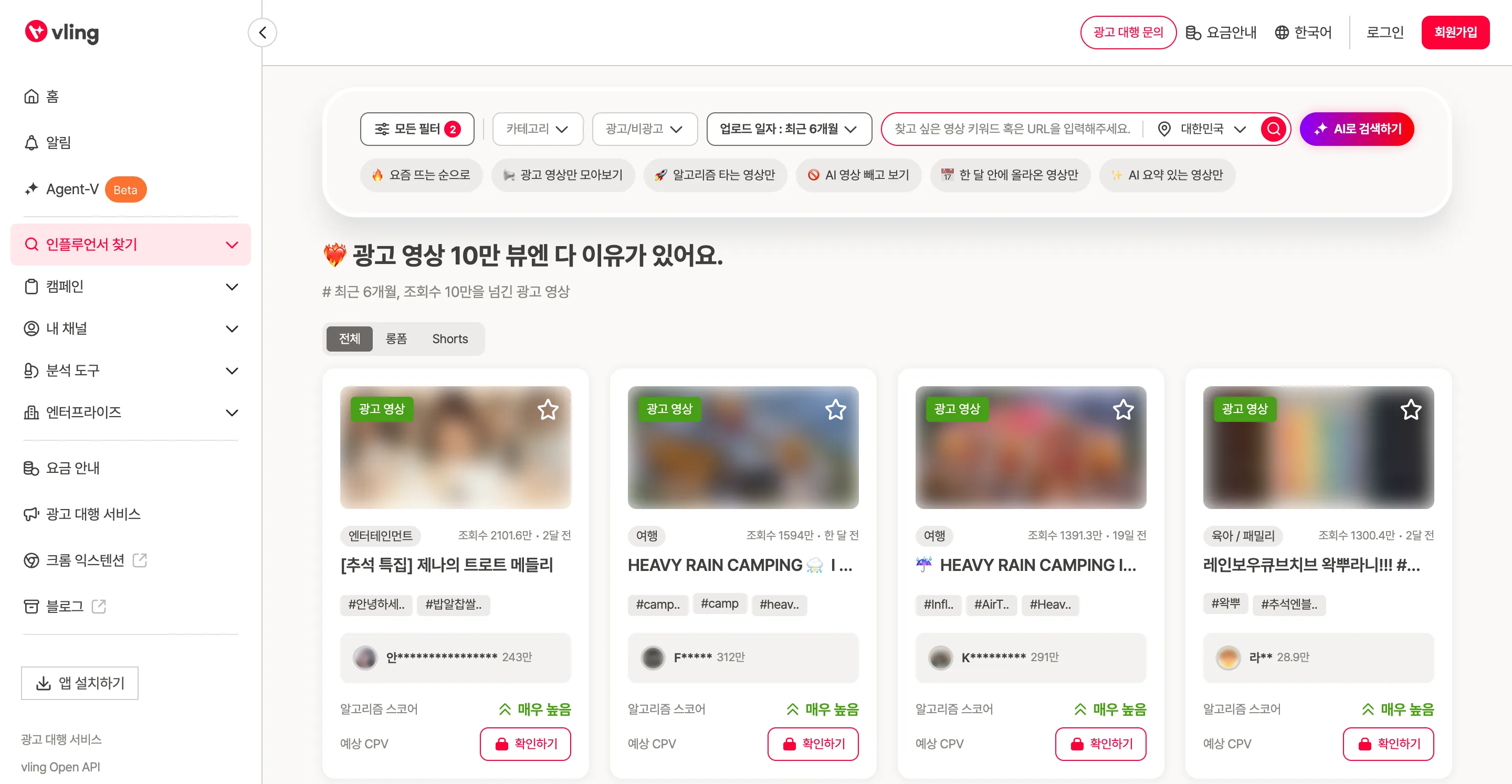
Video search. I built the results grid with teammates (the curation sections were a teammate's). Channel names are masked by the service; thumbnails and profile photos are blurred. See the live page 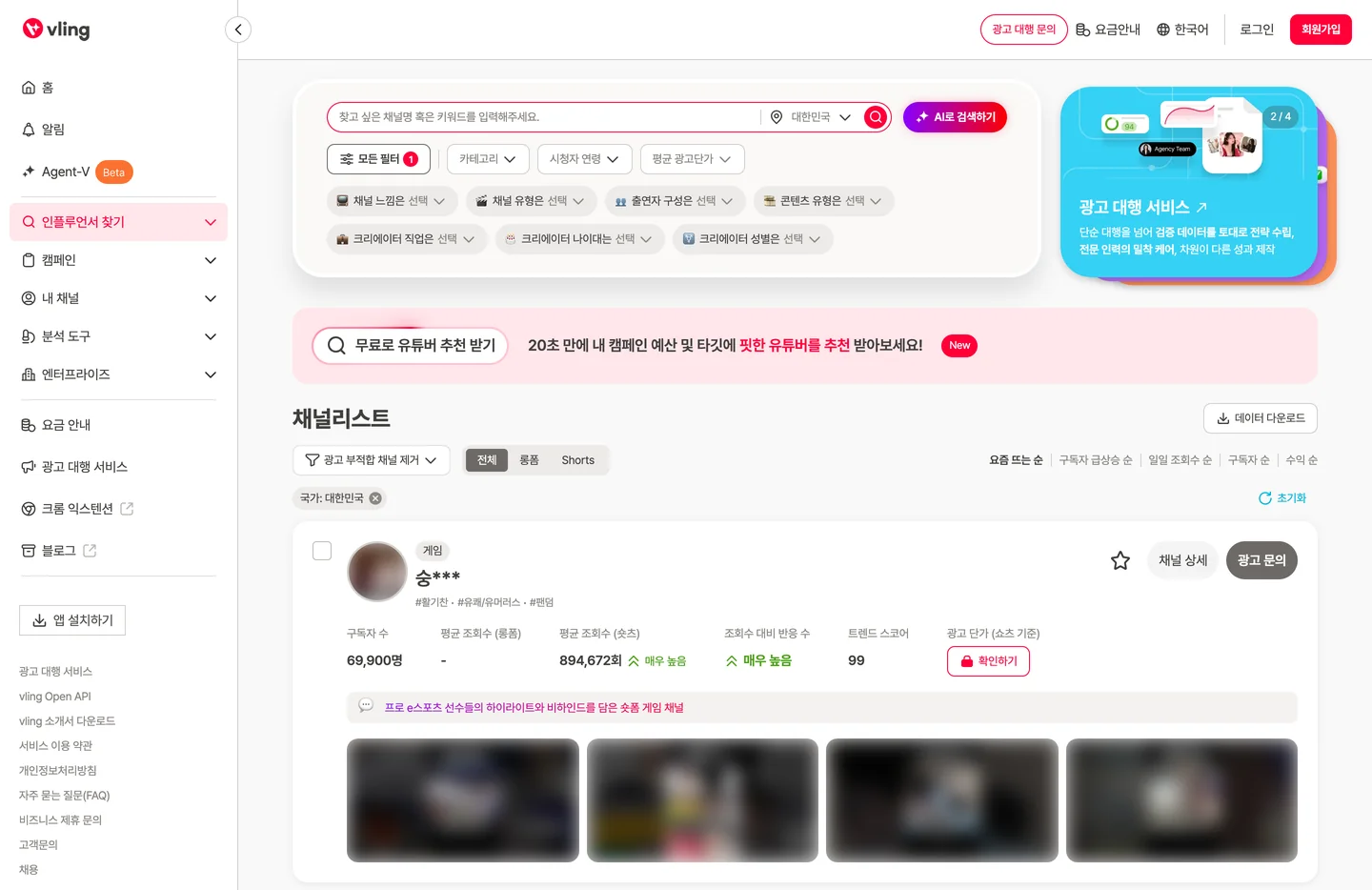
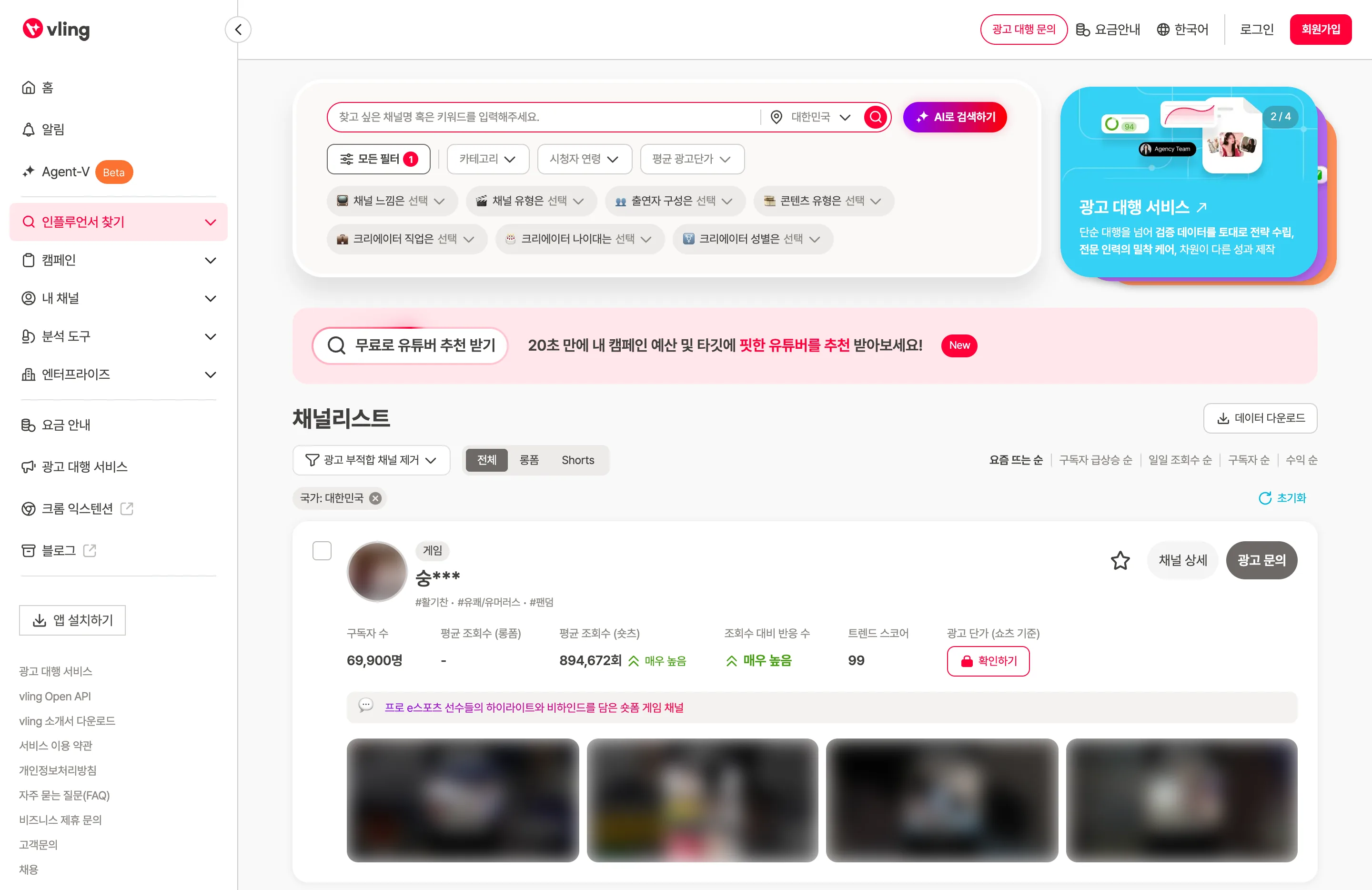
Channel search. I built the channel cards and part of the channel attribute filters. Channel names are masked by the service; thumbnails and profile photos are blurred. See the live page - Problem
- During the channel search redesign, I found that a field used only after unlocking was in the list query, so depending on the plan, searches returned nothing or deducted views incorrectly.
- Solution
- The value is not displayed while locked, so I removed it from the list query and now fetch it one channel at a time when the lock is lifted.
- Result
- Shipped the video search (Sep 8) and channel search (Sep 9) redesigns to production. I did the list query split, channel cards, URL search, and moving favorites between folders; teammates did the curation sections and the folder feature; we built the video results grid and the channel attribute filters together.
Decisions and reasoning
- Selecting a channel in autocomplete with the arrow keys and pressing Enter opened the channel and also ran a search, deducting a search the user never saw. Two key handlers on the same input ran in sequence, so the second now ignores Enter when the first has already handled it.
- During the redesign, a refactor renamed the search GraphQL operation, so the usage rules no longer matched it. It threw no error, so nothing showed on screen; I traced the mismatch and fixed the name.
- On re-entry from a shared URL, an unknown category value made the query fail, and a 115-character playlist URL was cut off by the 100-character input limit. Category values are now validated and unknown ones ignored, and the length limit is checked on submit rather than while typing.
Role
- As a frontend intern, I split the channel search (started July 20) and video search (started August 5) redesigns with teammates.
TypeScript, React, Next.js, GraphQL (Apollo Client), Zustand
Vling Search Page Performance Measurement and Improvement
CLS 0.246 → 0.003 (sandbox)
- Problem
- Only the search screen shifted heavily while loading (CLS 0.246), and changing the sort froze it on the old results for over 2 seconds.
- Solution
- Measurement scripts showed the cause was skeleton keys set to array indexes, which I changed to grid slot numbers. Sort changes no longer refetch server-rendered data unrelated to the results, thanks to shallow routing.
- Result
- CLS 0.246 → 0.003, skeleton after a sort change 2,194ms → 40ms, 'vlog' search 8.6s → 2.4s (sandbox measurements).
Decisions and reasoning
- The home page had a CLS of 0.002, but only the search page had 0.246. The cause of the CLS was that the skeleton key was the array index.
- Each time a card was finalized, the remaining skeletons shifted to later slots.
- When several cards were finalized at once, the skeletons moved together, so a single shift exceeded 0.1.
- I changed the key to the absolute slot number in the grid.
- Every time sort or filter changed, the router re-ran the server data function and transferred about 115KB.
- The response content for a sort change was the same even when the query changed, so a server round trip was not needed.
- So I changed 21 routing calls on the search page to shallow routing.
- With optimization, thumbnails download about 32KB less each (54.4KB → 22.7KB).
- Still, I accepted the extra 32KB rather than delay each grid card by 800ms, so only thumbnails skip optimization.
- A condition split two-word keywords and admitted a candidate if any one word matched, so one two-word query ('convenience store new items') grew to 1,330K candidates.
- Removing that condition cut it to 22K.
- Separately, with no period condition the search scanned everything, so a search for 'vlog' took 8.6 seconds.
- Setting the default period to the last 6 months brought it to 2.4s (candidates 1.2M to 130K). The two other keywords measured with it went from 4.5s to 1.7s ('mukbang') and from 2.8s to 1.7s ('travel').
Measurements
- With a one-line fix, CLS went from 0.161 → 0.001 in the local reproduction and 0.246 → 0.003 in the sandbox.
- Loading time and search time stayed the same, so this is an improvement in stability, not speed.
Limits
- All numbers were measured in a sandbox or locally; production was not measured because of access rules.
- The sample size was 1 to 5 runs, and the same measurement log shows a ±30% cold and warm variation, so read these as direction and magnitude, not exact ratios.
Next.js, React, Web Vitals, Playwright
Side Projects07~08
Lo.ci Location-Based SNS
Aggregate on write, not read
Solo backend
Aggregate on writemap query structure changed, before and after time not measured
- Problem
- Every map move re-aggregated all posts.
- Solution
- Posts are pre-aggregated per H3 cell when written, and the map reads only the aggregate rows.
- Result
- The query structure changed, but I did not measure before and after, so there is no number for the gain.
Decisions and reasoning
- The post table also had no latitude and longitude index.
- The map does not need individual posts. It needs the number of friends' posts in a cell and the latest thumbnail.
- In case the new query was wrong, I made it switchable with the old query through a configuration flag. If the new query throws an exception, it falls back to the old query.
- If the same user posted to the same cell almost at the same time, two aggregate rows could be created or a count could be lost.
- I added a unique constraint and took a pessimistic row lock for updates. If concurrent attempts to create the first row hit the constraint, the operation retries.
- I fixed N+1 queries with JPA's @BatchSize and JOIN FETCH.
Limits
- The only test was context loading, and I could not verify the concurrent update handling with a load test.
- Because the aggregate update is async, the aggregate can drift if even the retry fails.
- The IN list also grows as the number of friends grows.
Java, Spring Boot, JPA, MySQL, Redis, Uber H3
Pinta (Lo.ci Redesign)
Stats queries 3 → 1
App team, solo backend
3 → 1profile statistics queries
- Problem
- Every request re-read the account status from the DB, and profile statistics were split across 3 queries.
- Solution
- Account status moved to a 30-second cache, and profile statistics to 1 aggregate query.
- Result
- Removed the per-request account lookup and cut the stats queries from 3 to 1 (time not measured).
Decisions and reasoning
- For images, I moved on-demand resizing behind CloudFront from Lambda@Edge to imgproxy on EC2.
Limits
- Because of the cache, an account can still pass the check for up to 30 seconds after its user leaves the service or the account is deleted. I did not build invalidation logic to prevent this.
Java, Spring Boot, MySQL, Caffeine, CloudFront, Lambda@Edge, imgproxy, Flyway
Personal Projects09~11
History: Personal Work Record Pipeline
Answer in top 10: 25 → 29 of 35
25 → 29of 35 questions with the answer in the top 10
- Problem
- By default, Claude Code deletes conversations after 30 days, so past decisions and their reasons could not be found again.
- Solution
- Conversations, commits and documents are collected and indexed automatically when a work session starts or ends, and each day's decisions and reasons are extracted with their source records and served through a search server (MCP) that combines keyword and semantic search.
- Result
- About 540,000 records in the full-text index as of November 17, 2026 (about 90,000 of them embedded), with about 1,400 decision records as of November 11. To reduce documents losing out to conversation messages on reworded questions, I added a channel that pulls document candidates separately: questions with the answer in the top 10 went from 25 to 29 of 35, and from 6 to 9 of 20 questions written after the design.
Decisions and reasoning
- I solved the clustered similarity scores by taking the top 100 results by cosine similarity, then re-ranking them with a bonus for documents.
- I also tried weight tuning, excluding short chunks, and switching to a larger model. The effect was small or none, so I did not include them.
- I measured the rate at which the answer is in the top 10, saved the baseline, and run the same benchmark every time I change search.
- In November, decision records and documents were still losing out to conversation messages on reworded questions. So I added a channel that pulls semantic search candidates from documents only and merges them in.
Measurements
- Even after adding semantic search, reworded questions only went from 0.333 to 0.417, which is 1 more out of 12.
- Looking at the cause, the embedding cosine similarities clustered at 0.86 to 0.91. So tens of thousands of conversation messages were pushing out the decision records and documents that should have been found.
- In October, on 43 questions, the share with the answer in the top 10 went from 0.74 to 0.84, mostly because of the 2-character index; semantic search alone moved it from 0.81 to 0.84.
- After adding the bonus, reworded questions went from 0.42 to 0.75 and the overall figure became 0.93.
- Other categories did not drop, and response time stayed at a p50 of 27ms.
- The November document channel was measured on a separate set of 35 questions and on 20 reworded questions written after the channel was designed.
- On the same day and database, questions with the answer in the top 10 went from 25 to 29 of 35 and MRR from 0.677 to 0.709 (same values in 2 runs).
- Among 30 reworded questions (10 of the 35 plus the 20 new ones), found answers went from 8 to 13; on the 20 new ones alone, from 6 to 9.
- The starting 25 already includes the 2-character index and semantic search, and response time did not increase.
Limits
- The October figures (0.84, 0.93) were tuned and evaluated on the same 43 questions and may be overfitted, so in November I measured on separately written questions. The 10 reworded questions among the 35 were looked at while designing the channel, so they are not fully held out.
- The evaluation questions were written by an agent. On reworded questions the results fell 1 to 3 short of the targets set in advance (9 against a target of 10 on the 20 new questions). The 20 new questions were also written by an agent that had read the design, so they are not fully held out.
- I run the benchmark by hand when I change search; it fails if results drop below the baseline. It is not wired into CI or deploy.
Python, TypeScript, Node.js, SQLite FTS5, MCP, ONNX
Hanpan: Game Alert iOS App
1.0 submitted to App Store review
13 → 0successful hijacks in 20 runs of the reproduced attack (before the fix → after)
- Problem
- An app that announces game starts becomes a stalking tool if you can register someone else's account. So alerts go only to accounts whose owner verified them, but the security review found that someone who pre-registered another person's Riot ID could take over that account the moment the real owner verified it.
- Solution
- I changed the server so only the latest registrant of an account can attempt verification, and only a challenge issued after the owner's verification can change the owner. The 10 new tests fail on the code before the fix.
- Result
- In 20 runs of the same attack script, successful hijacks went from 13 to 0. 1.0 was submitted to App Store review on November 23 with manual release, so I publish it myself even after approval.
Decisions and reasoning
- PUBG and Overwatch have no way to verify account ownership, so 1.0 keeps them for preview users only. Otherwise anyone who knows a nickname could get someone else's game start alerts.
- TestFlight and the App Store get the same binary, so which games are public is set per user on the server, not by a build flag.
- Because this was a production deploy, one agent built the change and a separate agent only checked it, working as a pair. The checking agent blocked the deploy in round 1 (a screen asking to pick several games when only one exists, and an app version still at 0.8.0). After the fixes, 212 server tests and 126 app tests were rerun and passed before the deploy.
- When a deploy was reported as done, the agent that hands out the work rechecked the remote commit and the production server's responses. It marked TestFlight processing, which it could not see, as reported but not verified.
Limits
- Two people use it now.
- One Medium finding from the review (one user can use up the Riot API limit and stop game detection for everyone) is left to fix before opening it wider.
Swift, SwiftUI, Node.js, SQLite, APNs, Riot API
Bento: Personal AI Assistant App
First sentence first, long answers verbatim
- Problem
- Even for questions that needed no tools, Fetch, the research assistant bot, took a median 5.7 seconds before the first content appeared.
- Solution
- Sonnet answers first with one sentence, and questions that need research or tools go to the original bot. The original bot's answer is not rewritten; it is split into paragraphs and sent.
- Result
- In a test setup, the first sentence of a knowledge question appeared in about 1.9 seconds. Since November 23 all 4 assistant bots use this front.
Decisions and reasoning
- At first the front model shortened long answers before sending them. When a separate agent that only checks the work tested 10 long answers, all 3 that were rewritten lost content (shortening dropped items, and restoring them duplicated items). So rewriting is off, and the original text is sent unchanged.
- Code checks the one sentence the front sends first. If it has numbers or words that are not in the source, or claims something is done, it is not sent, and the reply waits for the full answer.
- I compared Haiku and Sonnet on the same questions for the front and chose Sonnet. Haiku mixed its routing reason into the answer in 10 of 14 knowledge questions.
Measurements
- On 6 knowledge questions without tools, the original bot's first content took 3.2 to 11.7 seconds (median 5.7), and Sonnet's first sentence about 1.9 seconds (test setup).
Limits
- The first sentence time was measured in a test setup.
- On November 19 the agent building the front deployed to the production server before the QA verdict. The deployed code matched the passing version, so it was not rolled back, but deploying only after QA is still a written rule, not something a machine enforces.
Swift, SwiftUI, Node.js, Python, LLM API
Activities
- 2025.08 ~ 2026.08
9th cohort President, 10th cohort Vice President and Node.js Part Lead
UMC HUFS
- As president of the 9th cohort, I ran the developer community and designed the Spring Boot study curriculum.
- In the 10th cohort, I served as vice president and Node.js part lead.
- 2025.09 ~ 2025.12
Undergraduate Teaching Assistant, Deep Learning Basics (딥러닝기초)
Hankuk University of Foreign Studies (HUFS)
I supported labs and assignments for the Deep Learning Basics course and built a system that grades assignments automatically (Spring, React, FastAPI).
Spring, React, FastAPI
- 2025.11
VitaCheck Booth Operation
2025 Seoul Job Fair (Seoul Metropolitan Government and Industrial Bank of Korea)
- At the fair's UMC project demo zone, we showcased our team project VitaCheck, a supplement recommendation service, and gave live demos to visitors to collect feedback.
- On the 5-person team I handled the backend: QueryDSL pagination for ingredient searches by purpose, a duplicate ingredient check for Gemini recommendations, and Google login.
Java, Spring Boot, QueryDSL
- 2023.04 ~ 2024.10
Senior KATUSA, 1st Platoon
KATUSA, 557th MP Company
- Led about 20 KATUSA soldiers in the platoon, reporting directly to the ROK Army support NCO and the US platoon leader (SSG).
- Coordinated work and schedules between the US side and the ROK staff, and interpreted in person.
Education
- 2021.03 ~ 2027.02 (expected)
Computer Engineering
Hankuk University of Foreign Studies (HUFS)
Awards
- 2022
H-UP First Place (최우수상)
HUFS career exploration credit program
I received the award for an educational iOS app that uses games to teach basic operations to people who struggle with smartphones.
Skills
- Server
- Java, Spring Boot, JPA, QueryDSL, Node.js, Python
- Realtime
- WebSocket (STOMP)
- Data
- MySQL, Flyway, SQLite
- Infrastructure
- AWS, Docker, nginx, GitHub Actions, Prometheus
- Web
- TypeScript, React, Next.js, GraphQL (Apollo Client), TanStack Query
- Apps
- Swift, SwiftUI
- AI
- LLM APIs (Gemini, OpenRouter), LLM output validation, MCP, Embedding search, Claude Code